Univ.-Prof. Dr. Matthias Horn

Microbial symbioses and the Intracellular Style of Living
Symbiosis, the living together of two dissimilar organisms (De Bary, 1898), is a fundamental principle in nature, which contributed to the origin of eukaryotes around two billion years ago and continues to have a profound impact on the ecology and evolution of all extant organisms. My lab is interested in microbial symbioses in which eukaryotes serve as hosts for intracellular bacteria and viruses. By focusing on selected model systems, we are studying molecular and evolutionary mechanisms underlying and driving these associations.
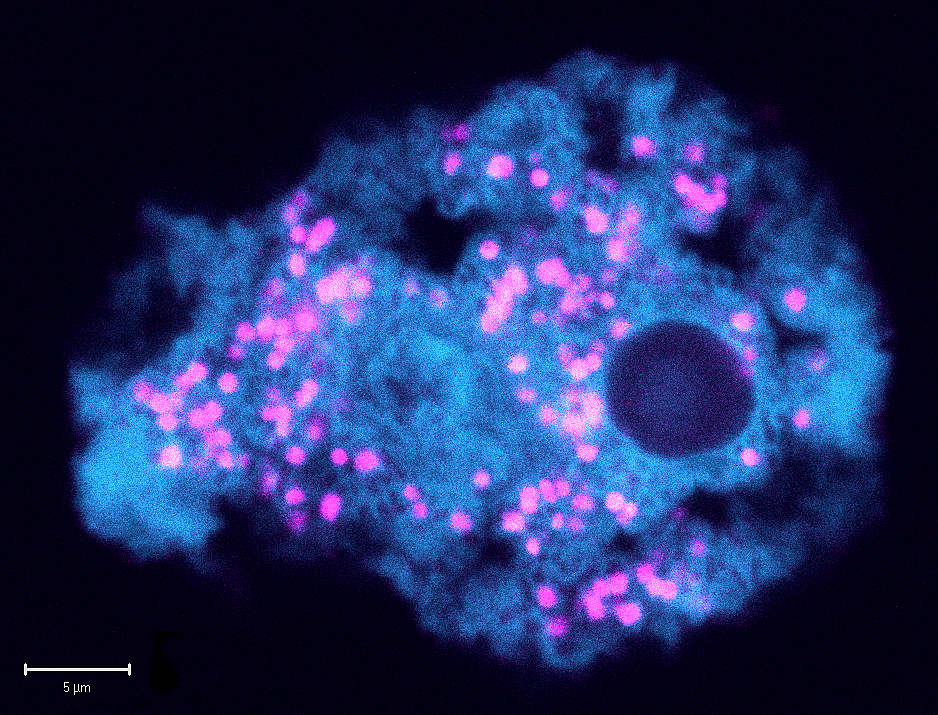 Our research combines current approaches from microbial ecology, evolutionary biology, and cellular and molecular microbiology. Common to all our models is the lack of methods to culture the microbial symbiosis partners independently in the lab. We thus use a broad spectrum of cultivation-independent, molecular biology techniques including fluorescence in situ hybridization, comparative genomics, metagenomics and transcriptomics using next generation sequencing, proteomics, chemical imaging, phylogenetic and molecular evolution analyses.
Research Themes
The evolution and biology of strictly intracellular microbes
Chlamydiae are well-known as important pathogens of humans but have more recently also been found as symbionts of free-living amoebae. Molecular surveys suggest that the chlamydiae are highly diverse, likely infecting almost any animal lineage. They represent one of the evolutionary oldest strictly intracellular groups of microbes, with their last common ancestor having lived around one billion years ago. Studying chlamydial symbionts such as Protochlamydia amoebophila and Parachlamydia acanthamoebae, the comparison with their pathogenic counterparts, as well as evolution experiments using these symbionts allow us to investigate the evolution of the intracellular lifestyle of chlamydiae and their adaptation to different eukaryotic hosts.
At DoME, this research is carried out together with Astrid Collingro.
Recent project: Chlamydial symbionts in dictyostelids
The soil amoeba Dictyostelium discoideum is one of the best-known protist model systems and famous for its so-called social life cycle, a conserved mechanism found in all dictyostelids. During this life cycle, tens of thousands of cells aggregate and develop multicellular structures, eventually leading to the formation of spores. Recent evidence suggests that in nature chlamydial symbionts are widespread among dictyostelids. In this project, we aim to understand the diversity of chlamydial symbionts in dictyostelids and ask how chlamydiae adapted to the specific social life cycle of dictyostelid amoebae.
Collaboration partners: Susanne DiSalvo (Southern Illinois University Edwardsville), Tamara Haselkorn (University of Central Arkansas), Thiery Soldati (University of Geneva)
Selected publications on this theme:
- Dharamshi JE, Köstlbacher S, Schön ME, Collingro A, Ettema TJG, Horn M. 2023. Gene gain facilitated endosymbiotic evolution of Chlamydiae. Nat Microbiol, 1: 40-54 http://dx.doi.org/10.1038/s41564-022-01284-9
- Köstlbacher S, Collingro A, Halter T, Schulz F, Jungbluth SP, Horn M. 2021. Pangenomics reveals alternative environmental lifestyles among chlamydiae. Nature Commun., 12: 4021; http://dx.doi.org/10.1038/s41467-021-24294-3
- Collingro A, Köstlbacher S, Horn M. 2020. Chlamydiae in the Environment. Trends Microbiol, 11: 877-888 http://dx.doi.org/10.1016/j.tim.2020.05.020
- Herrera P, Schuster L, Wentrup C, König L, Kempinger T, Na H, Schwarz J, Köstlbacher S, Wascher F, Zojer M, Rattei T, Horn M. 2020. Molecular causes of an evolutionary shift along the parasitism-mutualism continuum in a bacterial symbiont. Proc. Natl. Acad. Sci. U.S.A., 117: 21658-21666; http://dx.doi.org/10.1073/pnas.2005536117
- Lagkouvardos I, Weinmaier T, Lauro FM, Cavicchioli R, Rattei T, Horn M. 2014. Integrating metagenomic and amplicon databases to resolve the phylogenetic and ecological diversity of the Chlamydiae. ISME J. 1: 115-25; http://dx.doi.org/10.1038/ismej.2013.142
- Horn M. 2008. Chlamydiae as symbionts in eukaryotes. Ann. Rev. Microbiol. 62: 113-131. http://dx.doi.org/10.1146/annurev.micro.62.081307.162818
Giant viruses - diversity, evolution, host adaptation, and population dynamics
Viruses are the most abundant biological entities infecting all cellular life forms with major consequences for their individual hosts and entire ecosystems. Yet, they are also the most unknown biological players, with the protist-infecting nucleocytoplasmic large DNA viruses (Nucleocytoviricota), also referred to as giant viruses, as one of the more recent discoveries that challenged our perception of the viral world. Giant viruses are as large as bacteria both in terms of particle and genome size, and share a number of features previously observed in cellular microorganisms only.
Our current knowledge about these unusual viruses is predominantly based on few isolates obtained with a very limited number of protist host species, while metagenomic data suggests a tremendous diversity of yet undiscovered viruses infecting microbial eukaryotes. We participated in the discovery of the Klosneuvirinae, a group of giant viruses with a record-holding large number of translation-related genes. More recently, we have shown how bacterial symbionts help amoeba hosts to counter infections by giant viruses, representing one of the very few giant virus defense mechanisms in protists.
Recent projects: Giant viruses in the wild
To further uncover giant virus diversity, we use targeted co-cultivation with alternative protist hosts for the isolation of new giant viruses. This is complemented by targeted enrichment of heterotrophic protists and giant viruses directly from environmental samples and subsequent metagenomics and mini-metagenomics analyses. We also study giant viruses using experimental evolution approaches, and we use time series data and microcosm experiments to investigate giant viruses and their hosts in complex microbial communities.
At DoME, this research is carried out together with Anouk Willemsen.
Selected publications on this theme:
- Arthofer P, Delafont V, Willemsen A, Panhölzl F, Horn M. 2022. Defensive symbiosis against giant viruses in amoebae. PNAS, 119: e2205856119. http://dx.doi.org/10.1073/pnas.2205856119
- Schulz F, Yutin N, Ivanova NN, Ortega DR, Lee TK, Vierheilig J, Daims H, Horn M, Wagner M, Jensen GJ, Kyrpides NC, Koonin EV, Woyke T. 2017. Giant viruses with an expanded complement of translation system components. Science, 6333: 82-85. http://dx.doi.org/10.1126/science.aal4657
Microbe-host interaction in protists
Many protists harbor specific bacterial symbionts. The function of these symbionts is, however, mostly unknown, and so are the underlying mechanisms of host interactions. We are using diverse model systems to better understand the role of microbial symbionts for their protist hosts. We have shown that chlamydial symbionts can protect amoeba from lethal infections with the bacterial pathogen Legionella pneumoniae, and we have described an unusual protein secretion system in the amoeba symbiont Amoebophilus asiaticus. We study amoeba symbionts such as Nucleicultrix amoebiphila to better understand how bacteria target and replicate in the nucleus of their host cells.
Selected publications on this theme:
- König L, Wentrup C, Schulz F, Wascher F, Escola S, Swanson MS, Buchrieser C, Horn M. 2019. Symbiont-mediated defense against Legionella pneumophila in amoebae. mBio 10: e00333-19. http://dx.doi.org/10.1128/mBio.00333-19
- Böck D, Medeiros JM, Tsao HF, Penz T, Weiss GL, Aistleitner K, Horn M, Pilhofer M. 2017. In situ architecture, function, and evolution of a contractile injection system. Science 6352: 713-717. http://dx.doi.org/10.1126/science.aan7904
- Schulz F, Horn M. 2015. Intranuclear bacteria: inside the cellular control center of eukaryotes. Trends Cell Biol. doi: 10.1016/j.tcb.2015.01.002. http://dx.doi.org/10.1016/j.tcb.2015.01.002
- Schulz F, Lagkouvardos I, Wascher F, Aistleitner K, Kostanjsek R, Horn M. 2014. Life in an unusual intracellular niche: a bacterial symbiont infecting the nucleus of amoebae. ISME J. 8: 1634-1644. http://dx.doi.org/10.1038/ismej.2014.5
- Horn M, Wagner M. 2004. Bacterial endosymbionts of free-living amoebae. J. Euk. Microbiol., 51: 509-514
Bacterial symbionts in arthropods
Arthropods and their bacterial symbionts represent well-known models for studying microbial symbiosis and the interaction between microbes and animal. In our lab, we are particularly interested in the less well studied microbial symbionts and arthropod groups and have investigated bacterial symbionts in the wood louse Porcellio scaber, the dwarf spider Oedothorax gibbosus, mealybugs, and adelgids of the Adelges laricis/Adelges tardus species complex.
At DoME, this research is carried out together with Alejandro Manzano Marin.
Selected publications on this theme:
- Halter T, Köstlbacher S, Rattei T, Hendrickx F, Manzano-Marín A, Horn M. One to host them all: genomics of the diverse bacterial endosymbionts of the spider Oedothorax gibbosus. 2023 - Microb. Genomics, 9: 10.1099/mgen.0.00094 http://dx.doi.org/10.1099/mgen.0.000943
- Szabó G, Schulz F, Manzano-Marín A, Toenshoff ER, Horn M. 2022. Evolutionarily recent dual obligatory symbiosis among adelgids indicates a transition between fungus- and insect-associated lifestyles. ISME J, 1: 247-256 http://dx.doi.org/10.1038/s41396-021-01056-z
- Szabó G, Schulz F, Toenshoff ER, Volland JM, Finkel OM, Belkin S, Horn M. 2017. Convergent patterns in the evolution of mealybug symbioses involving different intrabacterial symbionts. ISME J, 3: 715-726. http://dx.doi.org/10.1038/ismej.2016.148
Doctoral program on microbial symbiosis
Matthias Horn is coordinating a doctoral program on microbial symbiosis, which is funded by the Austrian Science Fund doc.funds project MAINTAIN and the University of Vienna and provides a unique framework and specific training program within the University of Vienna Doctoral School in Microbiology and Environmental Science.
JOINING THE TEAM
If you are interested in joining our team with your own fellowship, please get in touch with Matthias or check out our PhD & postdoc program.
Funding
Matthias Horn is a member of the Austrian Science Fund Cluster of Excellence Microbiomes Drive Planetary Health.

Our research has received financial support from: